
 BOOK AN APPOINTMENT
When a Medical Emergency Is Unclear A Common Situation in Dubai
In Dubai and Sharjah, medical decisions are rarely simple.
A sudden fever late at night.
Chest discomfort that causes anxiety.
A child gets injured during play.
Severe stomach pain that comes and goes.
In these moments, most people don’t panic immediately; instead, they hesitate.
The question isn’t just what is wrong, but how serious it is. Many residents in the UAE, especially families and working professionals, struggle with this exact uncertainty. Going to a hospital emergency room feels extreme. Waiting at home feels risky. Clinics feel accessible, but people worry about whether it’s enough.
This confusion is common because not every serious-feeling symptom is actually life-threatening and not every calm-looking symptom is safe to ignore.
In the UAE, hesitation is often influenced by practical concerns:
- Not knowing whether the situation qualifies as an emergency
- Fear of unnecessary hospital admission
- Uncertainty around insurance and costs
- Busy schedules and long working hours
- Concern about overreacting
Parents feel this pressure deeply. When a child is unwell or injured, every symptom feels important. Adults feel it too balancing health decisions with work, family, and responsibilities.
The problem is not lack of care.
The problem is lack of clarity.
Most medical situations fall into a grey area urgent enough to need medical attention, but not dangerous enough to require emergency-level care. When people don’t understand this difference, they either delay care or rush to the wrong place.
That hesitation increases stress, prolongs discomfort, and sometimes worsens outcomes.
Understanding when a condition is urgent versus when it is an emergency removes fear from the decision. It allows patients to act confidently instead of guessing.
This is where the right guidance and the right level of care makes all the difference.
What Urgent Care Is Designed to Handle in the UAE
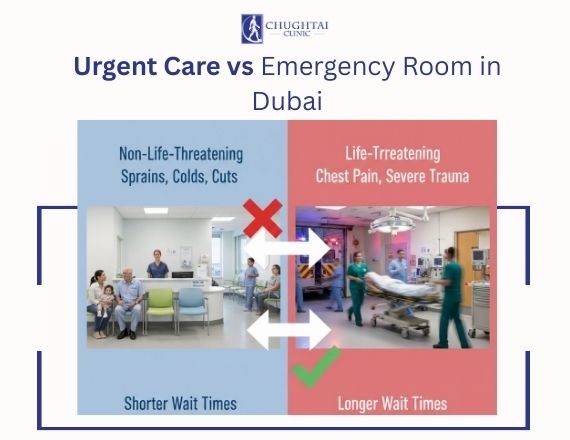
Urgent care exists for situations that need medical attention soon, but are not immediately life-threatening. In Dubai and Sharjah, many medical concerns fall into this category: uncomfortable, worrying, or painful, but stable.
This is where people often get stuck. Symptoms feel serious enough to seek help, yet not severe enough to justify an emergency room visit. Urgent care fills this gap by offering timely medical evaluation without the intensity of hospital emergency care.
Urgent care is appropriate when:
- The person is awake, alert, and responsive
- Breathing is stable and not severely distressed
- Pain is present but not crushing or rapidly worsening
- Bleeding is controlled
- Symptoms are concerning but not escalating quickly
Common reasons patients seek urgent care in the UAE include sudden illnesses, minor injuries, infections, and unexplained pain that disrupts daily life.
These situations often include:
- Fever, sore throat, cough, or flu-like symptoms
- Ear pain, sinus issues, or mild breathing discomfort
- Minor cuts, burns, or wounds
- Sprains, strains, and muscle injuries
- Joint pain or swelling after activity
- Mild allergic reactions without airway involvement
- Skin rashes or localized infections
Urgent care clinics are structured to assess symptoms carefully, not just treat them quickly. Providers evaluate whether a condition can be safely managed on site or requires escalation. If warning signs appear during assessment, patients are guided immediately to higher-level care.
For many families and professionals in Dubai, urgent care offers clarity at the right time. Instead of waiting at home with uncertainty, patients receive answers, treatment, and guidance without unnecessary delay.
This approach reduces stress, prevents complications, and allows people to return to normal life sooner.
When the Emergency Room Is the Only Safe Option
Some medical situations are not urgent-care problems, they are emergencies. In these moments, the priority is speed, advanced monitoring, and hospital-level intervention. Waiting, observing at home, or visiting a clinic first can be dangerous.
You should go to the emergency room immediately if any of the following are present:
- Chest pain, pressure, or tightness, especially if it spreads to the arm, jaw, or back
- Severe difficulty breathing or sudden shortness of breath
- Signs of a stroke, such as facial drooping, weakness on one side, confusion, or trouble speaking
- Severe or worsening abdominal pain
- Heavy or uncontrolled bleeding
- Major trauma from road accidents, high falls, or blunt force
- Loss of consciousness, fainting, or seizures
- Severe allergic reactions with throat swelling or breathing difficulty
These conditions require resources that clinics are not meant to provide, including advanced imaging, continuous monitoring, and emergency interventions. In such cases, going straight to the emergency room is the safest and correct decision.
A common mistake is delaying emergency care because symptoms come and go, or because someone hopes the problem will settle. In true emergencies, time matters. Minutes can make a difference in outcomes.
It’s important to understand that choosing the emergency room when these symptoms are present is not overreacting. It is responsible and necessary.
Urgent care and emergency care serve different roles. Knowing when a situation crosses from urgent into emergency removes doubt and protects lives.
Why Most People Choose the Wrong Place and How to Decide Calmly
In Dubai and Sharjah, people rarely choose the wrong level of care because they are careless. They choose wrong because symptoms don’t speak clearly.
Pain feels intense, so it feels like an emergency even when it isn’t.
Fear rises quickly even when the condition is stable.
Waiting feels risky but going to the hospital unnecessarily also feels overwhelming.
This confusion is normal.
Many medical problems sit in a grey zone. They are uncomfortable, alarming, and disruptive but not immediately dangerous. Without guidance, people either delay care at home or rush to the emergency room out of fear.
The safest way to decide is to focus on severity, not discomfort.
Ask yourself:
- Is breathing severely affected or getting worse?
- Is the person confused, fainting, or not fully responsive?
- Is bleeding heavy and uncontrolled?
- Is the pain sudden, crushing, or spreading?
- Did the injury involve major force or trauma?
If the answer to any of these is yes, emergency care is the correct choice.
If symptoms are painful, worrying, or limiting daily activity but stable, urgent care is often the right first step. Medical providers can assess the situation properly and decide whether treatment can be provided safely or if hospital care is needed.
Many people worry that visiting urgent care first might delay serious treatment. In reality, urgent care clinics are trained to recognize danger signs early. If something is beyond what can be safely managed, patients are directed immediately to emergency services.
The goal is not to guess perfectly.
The goal is to avoid waiting at home while uncertainty grows.
Getting evaluated early reduces anxiety, prevents complications, and ensures the right care is given at the right time.
How Chughtai Clinic Dubai Fits Into This Decision
When a medical situation feels urgent but unclear, the most important step is not staying at home guessing. Early evaluation brings clarity whether treatment is provided immediately or you’re guided to higher-level care.
Chughtai Clinic Dubai is positioned to support patients during these uncertain moments. Many people arrive worried, uncomfortable, or unsure where they should have gone. The goal of the visit is simple: understand what’s happening and decide the safest next step.
At Chughtai Clinic Dubai, urgent care focuses on:
- Careful medical assessment based on symptoms and history
- Clear explanations in plain language
- Timely treatment for non-life-threatening conditions
- Immediate referral if emergency care is required
Urgent care does not replace the emergency room. It works alongside it. Many conditions that feel frightening at first can be safely evaluated and managed without hospital admission. Others need escalation and recognizing that early protects patient safety.
For families, professionals, and individuals across Dubai and Sharjah, this approach reduces unnecessary stress. Instead of choosing between extremes, patients receive guidance based on medical judgment, not fear.
Knowing where to go and why removes hesitation.
Getting evaluated early prevents complications.
Choosing the right level of care leads to better outcomes.
Medical Disclaimer
This content is for general educational purposes only and does not replace professional medical advice, diagnosis, or treatment. Every medical situation is different.
If you or someone else experiences severe symptoms, rapid deterioration, or signs of a medical emergency, seek immediate emergency care.